Commercial Tech Talk
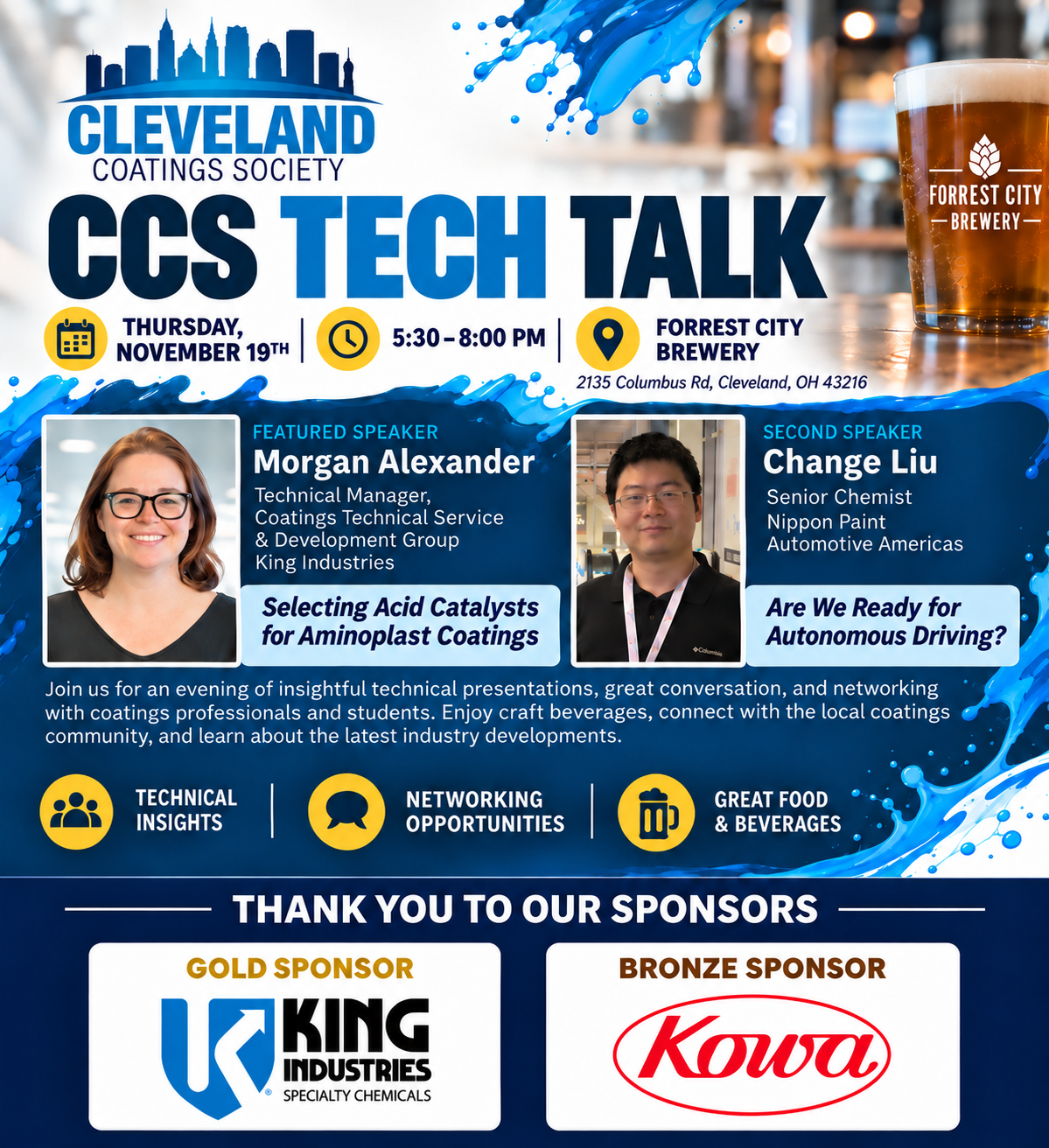
Selecting Acid Catalysts for Aminoplast Coatings
This presentation will provide an overview of aminoplast crosslinkers – including categories, advantages, and general reactivity – before exploring key considerations for formulators when selecting the proper acid catalyst for a coating. In addition to lowering energy demands and achieving suitable cure, an optimized catalyst can provide improvements to aminoplast-crosslinked systems such as package stability, intercoat adhesion, and corrosion resistance. Acid catalysts, while most familiar in melamine-crosslinked coatings, have increasingly broader use in hybrid formulations and wide-ranging applications. This presentation will include a discussion of available catalyst chemistries as well as key products for specific markets such as coil coatings, food contact packaging, automotive applications, and more.
Morgan Alexander is the Technical Manager for the Coatings Technical Service & Development Group at King Industries. Based at King’s headquarters in Norwalk, Connecticut – she has over 10 years of experience with a variety of specialty additives for CASE and Foam applications, with a predominant focus in acid catalysis of aminoplast coatings. Morgan began working at King Industries in 2015 as a Technical Service Chemist after receiving an ACS-accredited Bachelor of Science in Chemistry from The University of Connecticut.
Technical Talk
Are we ready for autonomous driving?
Autonomous driving has been a topic of interest since the 1920s, when engineer Francis Houdina demonstrated a radio-controlled vehicle on the streets of New York City. Since then, numerous futuristic visions of autonomous transportation have been portrayed in movies, television shows, and video games, capturing the imagination of both engineers and the public. The motivations for pursuing autonomous driving are diverse, ranging from improved mobility and transportation efficiency to reduced operating costs and enhanced user convenience. However, these motivations ultimately converge on a common objective: safety. While significant progress has been made in developing software, algorithms, and sensing technologies capable of supporting safe autonomous operation, questions remain regarding the readiness and feasibility of the supporting infrastructure required for widespread deployment. As autonomous driving technology continues to mature, it is important to evaluate whether we are adequately preparing the environment in which it will operate. To better understand the challenges and opportunities ahead, let’s explore the infrastructure, materials, and supporting technologies that can contribute to the successful adoption and maturation of autonomous driving systems.
Chang Liu is a senior chemist within Nippon Paint Automotive. Chang Liu earned his Ph.D. in Materials Science and Engineering, specializing in composites and nanomaterials, from the University of Dayton. He later worked as a research scholar at the Lerner Research Institute of the Cleveland Clinic Foundation, where he focused on medical devices and polymer development. He is currently a Senior Chemist at Nippon Paint Automotive Americas in Cleveland, Ohio. In this role, he leads OEM projects in their Product Development team and contributes to several innovative and emerging initiatives, including battery coatings, LiDAR functional coatings, and analytical failure analysis.